Kite surf Dahab: the lagoon, Blue Lagoon and the wind month by month
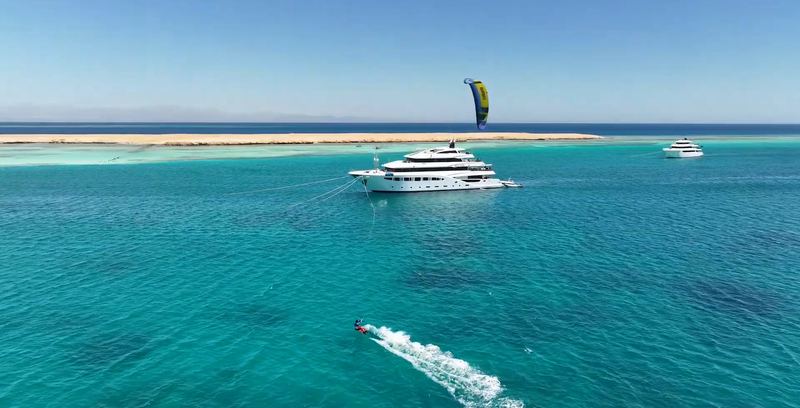
Dahab sits on the Gulf of Aqaba in Sinai, the wind mostly blows from the north, and the main kite spot is a shallow lagoon where you can stand almost everywhere.
If you want to kite surf in Dahab, Egypt, the main teaching spot is the flat-water kite lagoon south of the town centre. It is shallow, surrounded by sandbars, with cross-offshore wind and no waves or shorebreak. It suits practice on your riding and transitions, meaning changes of direction without stopping, when the tide provides enough water. For your first jumps, ask someone local to show you a spot with enough depth for a fall and a clear landing area.
Dahab is a small town in Sinai, best known for diving and windsurfing. For kiters 3 places matter: the lagoon, Asala beach at the north end of town, and Blue Lagoon, a remote lagoon in the Ras Abu Galum protected area.
How the wind works in Dahab
Dahab sits on the Gulf of Aqaba and the wind funnels down the gulf along the coast. The Dahab weather station that Windfinder uses for its 2003-2019 statistics mostly measured north to north-northeast wind, averaging 10 knots (5.1 m/s) with average gusts of 17 knots (8.7 m/s).
Windfinder calculates its statistics using daytime readings only. The station no longer reports, and its location affects the results, so I'd use the table to compare months rather than to predict the wind at a chosen spot. About 39% of all readings fall in Beaufort 4 to 6, which is 11-27 knots (6-14 m/s).
| Month | Dahab station average | Average gusts | Air temperature (NASA, 2001-2025) |
|---|---|---|---|
| January | 9 knots (4.6 m/s) | 16 knots (8.2 m/s) | 13 °C |
| February | 8 knots (4.1 m/s) | 14 knots (7.2 m/s) | 15 °C |
| March | 9 knots (4.6 m/s) | 16 knots (8.2 m/s) | 19 °C |
| April | 9 knots (4.6 m/s) | 16 knots (8.2 m/s) | 22 °C |
| May | 11 knots (5.7 m/s) | 18 knots (9.3 m/s) | 27 °C |
| June | 13 knots (6.7 m/s) | 21 knots (10.8 m/s) | 30 °C |
| July | 11 knots (5.7 m/s) | 19 knots (9.8 m/s) | 31 °C |
| August | 12 knots (6.2 m/s) | 21 knots (10.8 m/s) | 31 °C |
| September | 11 knots (5.7 m/s) | 19 knots (9.8 m/s) | 29 °C |
| October | 9 knots (4.6 m/s) | 16 knots (8.2 m/s) | 25 °C |
| November | 8 knots (4.1 m/s) | 15 knots (7.7 m/s) | 20 °C |
| December | 10 knots (5.1 m/s) | 18 knots (9.3 m/s) | 15 °C |
The station's highest averages run from May to September, with June on top. The NASA POWER model for the same coordinates shows a similar pattern, peaking in June and September. The temperature column is an approximate day-and-night average for 2001-2025 from a coarse model grid cell measuring 0.5° latitude × 0.625° longitude. The model returns an elevation of about 586 m for this point, so these are not measurements taken on the beach at sea level. I wouldn't pack clothes based on this table alone; check the coastal forecast before travelling.
The rhythm matters more than the average. A local guide describes wind on most days from March to November, with winter from December to February bringing several windy days followed by several calm ones; I wouldn't expect a regular cycle. For a winter week I wouldn't plan a session every day, and I'd keep the calm days for diving or a trip inland. Where else to go in the windiest month is covered in Where to kitesurf in June.
The lagoon: the main training spot
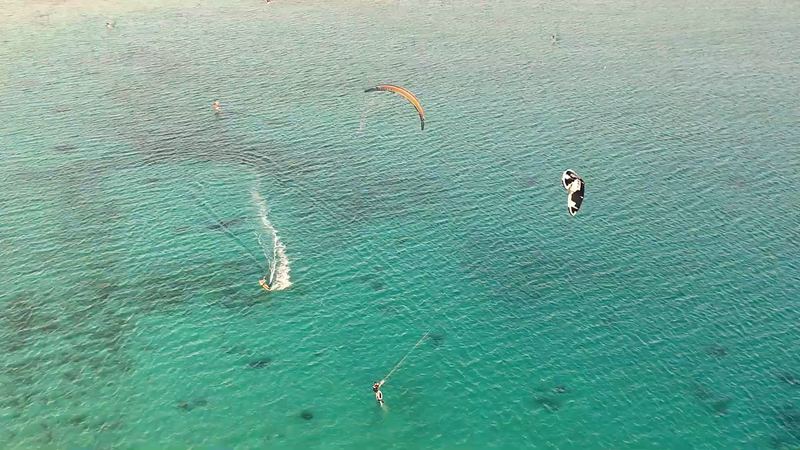
The small kite lagoon beside the schools is shallow, and you can stand in most of it. Sandbars surround it and the wind is cross-offshore. Depending on your position, the depth and what has happened, walking back may be possible, but I wouldn't rely on it to solve every problem. For beginners, I'd recommend lessons with an instructor here.
A few details that decide your session:
- Water depth depends on the tide. Schools time their lessons around the depth. Before practising jumps, check the landing area has enough water for a fall too; don't jump when it is too shallow.
- The schools are right on the lagoon. Give beginners and instructors space. Moving away from a lesson does not by itself mean you have found water deep enough for tricks.
- The open area for advanced riders is downwind of the windsurfers in area 2. You can launch from the public beach beside Centre 2. This is separate from the small teaching lagoon: with offshore wind, I'd only go out after a local briefing and with an operating rescue service and a way to contact the rescue team arranged in advance. Harry Nass provides its radio rescue service to affiliated clients during opening hours; passing visitors cannot automatically count on it.
- Kiting is prohibited in area 1, the windsurfing lagoon, and in Baby Bay. The centre describes an early crossing of the windsurfing lagoon before 9 am to reach the open area, not unrestricted riding outside certain hours. Have the permitted route and zone boundaries pointed out before launching.
To practise pop, a take-off by pushing against the board's heelside edge, I'd look for flat water without chop, the short, uneven waves created by wind. That lets you repeat the same movement without finding a gap between waves. I'd choose a place by its surface, depth and clear landing space, rather than by how comfortably I can stand in it.
Asala: small waves and onshore wind
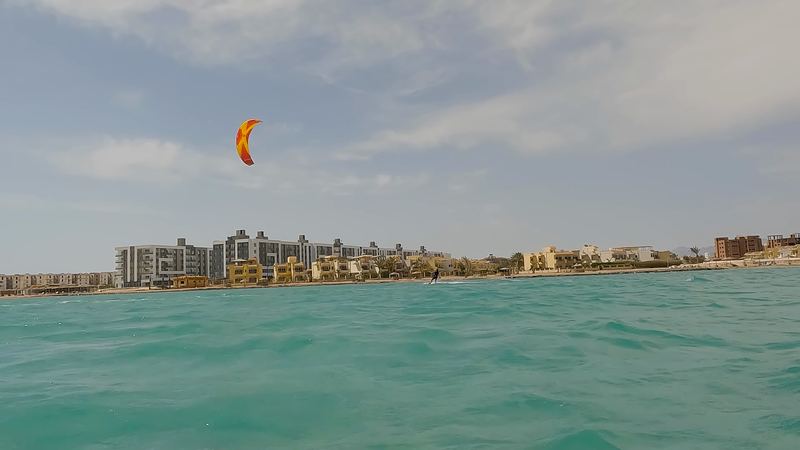
Asala beach at the north end of town is a completely different spot. The wind is onshore, there are small waves and a shorebreak, so getting off the beach takes confidence, and local guides recommend it for advanced riders. There are stones and coral in the water, so I'd definitely wear booties there.
If you are an intermediate rider, I'd save Asala for a day when you are already holding your ground upwind in the lagoon without thinking about it. If you can ride waves, it is a change from the flat water.
Blue Lagoon in Ras Abu Galum
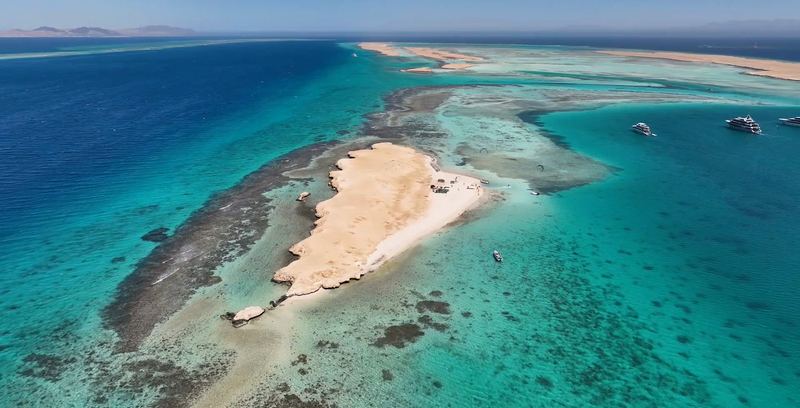
Blue Lagoon lies north of Dahab in the Ras Abu Galum protected area, which Egypt established in 1992. The walking route follows the coast from the Blue Hole and takes about 2 hours; a camel can carry your gear. Another option is a boat from the Blue Hole to Abu Galum, around 20 minutes, followed by a pickup truck to Blue Lagoon. Arrange the connections in both directions, including space for your kite gear, before setting off.
At the top of the bay the water is mirror-flat and the wind is cross-shore. There are simple huts at the water's edge where you can stay the night. With transport arranged, a 1-day trip is possible too. I'd stay at least 1 night if I wanted more time by the water and the freedom to check the wind in the morning without another transfer from Dahab.
For a stay outside town, I'd pack kite repair tape and a spare valve for my model, so a small repair needn't mean a trip back to Dahab.
Practical things
- Getting there: the closest international airport is Sharm El Sheikh, approximately 1 hour by car to Dahab; allow extra time for your destination and traffic. Visas, money and SIM cards are in Egypt for kiters: visas, money, SIM cards and getting to the spot.
- Wetsuit: in summer the water is 23-28 °C and 1 mm is enough, mainly against the sun. From December to February it is 19-23 °C and a 4/3 mm suit works well.
- Booties: a must at Asala, useful in the lagoon too.
- Kite: I'd discuss which sizes to bring for my dates with a local centre, then check the short-range forecast, including gusts, before packing. The kite size calculator is a starting point for a specific wind speed, weight and board; don't use a historical monthly average to choose your travel quiver, and check your model's wind range.
- Map: Find Dahab on its spot page and the kite spot map.
If you want to combine Dahab with another spot in Sinai, the closest is Sharm El Sheikh, and further north there is Ras Sudr; both are covered in Kitesurfing in Sharm El Sheikh and Ras Sudr. For the full overview of Egypt, see Kite spots in Egypt.
Dahab or a week on a boat
Dahab is a good pick if you want to stay in a town, have the lagoon close every day and go diving between sessions.
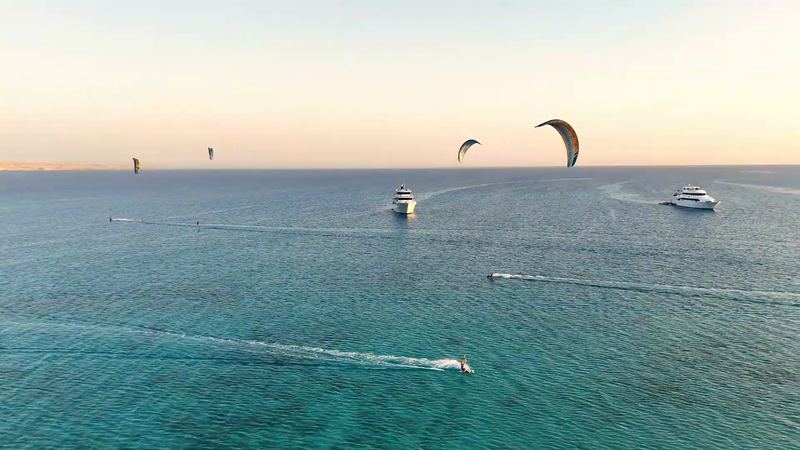
If you want feedback on your technique as well as time on the water, I'd consider a kite safari from Hurghada. The programme includes morning and afternoon riding as conditions allow and evening video coaching: you can watch your own riding and choose what to change in the next session. The mainland spots across the sea are compared in Kitesurfing in Hurghada and El Gouna.
Questions
When is the best wind for kitesurfing in Dahab?
According to the Dahab weather station (Windfinder, 2003-2019), June is the windiest month with an average of 13 knots (6.7 m/s), and May and July to September are strong too. February and November are the lightest at around 8 knots (4.1 m/s). These are historical daytime readings from a particular station, not a wind forecast for your spot.
Is the Dahab lagoon good for beginners?
Yes, schools teach in the small kite lagoon when the tide provides enough water. The wind is cross-offshore, so I'd start with an instructor; whether you can walk back depends on your position, the depth and the situation. The open area downwind of area 2 is a separate spot for independent advanced riders with rescue arranged in advance.
How do you get to Blue Lagoon from Dahab?
You can walk along the coast from the Blue Hole to Blue Lagoon north of Dahab in about 2 hours, with a camel carrying your gear. Another option is a boat from the Blue Hole to Abu Galum and a connecting pickup truck to Blue Lagoon. Arrange the full outward and return journey, including transport for your kite gear, beforehand.
What wetsuit do I need in Dahab?
In summer the water is 23-28 °C and 1 mm is enough, mainly for sun protection. From December to February the water is 19-23 °C and a 4/3 mm suit works well.
Which airport is closest to Dahab?
Sharm El Sheikh International Airport. The drive to Dahab takes approximately 1 hour; allow extra time for your destination and traffic.
Sources
- Christian and Karine's Popping tutorial: pop is a take-off against the heelside edge of the board; flat water is recommended for practice www.iksurfmag.com (checked 18 October 2026)
- K1 kite school glossary: chop means small, short wind-driven waves k1.surf (checked 18 October 2026)
- Wind statistics from the Dahab station, 1 Aug 2003 to 31 Dec 2019: average 10 knots (5.1 m/s), average gusts 17 knots (8.7 m/s), mostly NNE; monthly averages Jan-Dec 9.08 knots (4.7 m/s) / 8.06 knots (4.1 m/s) / 9.45 knots (4.9 m/s) / 9.46 knots (4.9 m/s) / 10.78 knots (5.5 m/s) / 12.62 knots (6.5 m/s) / 11.31 knots (5.8 m/s) / 11.96 knots (6.2 m/s) / 10.72 knots (5.5 m/s) / 9.18 knots (4.7 m/s) / 8.33 knots (4.3 m/s) / 10.36 knots (5.3 m/s); average gusts Jan-Dec 15.63 knots (8.0 m/s) / 14.06 knots (7.2 m/s) / 16.18 knots (8.3 m/s) / 15.82 knots (8.1 m/s) / 17.96 knots (9.2 m/s) / 20.96 knots (10.8 m/s) / 18.75 knots (9.6 m/s) / 20.5 knots (10.5 m/s) / 18.83 knots (9.7 m/s) / 16.23 knots (8.3 m/s) / 15.3 knots (7.9 m/s) / 17.85 knots (9.2 m/s); of 213,695 readings 38.7% at 4-6 Bft and 0.4% at 7-8 Bft; directions N 14.3%, NNE 18%, NE 7.4% www.windfinder.com (checked 18 October 2026)
- NASA POWER 2001-2025 climatology for 28.49 N, 34.51 E (model, 0.5° latitude × 0.625° longitude grid): mean air temperature Jan-Dec 13.4 / 15.2 / 18.5 / 22.4 / 26.8 / 29.5 / 31.2 / 31.2 / 28.9 / 25.3 / 19.6 / 15.1 °C; 10 m wind strongest in June and September; geometry returns an elevation of 585.78 m, not beach measurements power.larc.nasa.gov (checked 18 October 2026)
- Wind funnels down the Gulf of Aqaba; Kite Lagoon is shallow, you can stand in most places, cross-offshore, no waves or shorebreak; Assalah: onshore, small waves, shorebreak, stones and coral, wear boots; Blue Lagoon: mirror-flat water, cross-shore, huts at the water's edge, about a 2-hour walk along the coast from the Blue Hole with camels available to carry gear; windy most days March to November, winter described as several windy days and several calm days; water 23-28 °C in summer, 19-23 °C in winter, 1 mm in summer, 4/3 mm in winter www.iksurfmag.com (checked 18 October 2026)
- The lagoon is enclosed by sandbars you can walk back along to the beach; it is tide-influenced and lessons are timed for when there is enough water; the main kite centres are next to the lagoon www.active-traveller.com (checked 18 October 2026)
- Abu Galum Protectorate (South Sinai) was established in 1992 en.wikipedia.org (checked 18 October 2026)
- Abu Galum day trip: drive to the Blue Hole, then about 20 minutes by boat www.circledivers.com (checked 18 October 2026)
- Dahab is on the southeast coast of Sinai on the Gulf of Aqaba, about 80 km from Sharm El Sheikh, known for windsurfing and diving including the Blue Hole en.wikipedia.org (checked 18 October 2026)
- Kite safari from Hurghada: programme includes morning and afternoon riding as conditions allow, evening video coaching and ride analysis paradisekitesurf.cz (checked 18 October 2026)
- Windfinder calculates wind statistics using daytime readings only; station location and installation affect results www.windfinder.com (checked 18 October 2026)
- The small kite lagoon is separate from the open area downwind of the windsurfers in area 2; kiting is prohibited in area 1 and Baby Bay; the centre recommends station affiliation and radio rescue due to offshore wind www.harry-nass.com (checked 18 October 2026)
- Teaching in the kite lagoon depends on the tide; access to the open area via an early crossing of the windsurfing lagoon before 9 am or the public beach beside Centre 2; services require station affiliation, radio rescue operates during opening hours www.harry-nass.com (checked 18 October 2026)
- FLYSURFER SONIC RACE Gear Guide, pages 17 and 33: do not jump in shallow water, check shallows and obstacles, seek local advice, ensure rescue access and clear space downwind flysurfer.com (checked 18 October 2026)
- ZTrip offers a boat from the Blue Hole to Abu Galum and a connecting pickup truck to Blue Lagoon as part of a day trip ztripeg.com (checked 18 October 2026)
- The Egyptian Tourism Authority recommends a kite day trip to Blue Lagoon in Ras Abu Galum www.experienceegypt.eg (checked 18 October 2026)
- NASA POWER uses a 0.5° latitude × 0.625° longitude MERRA-2 grid for meteorological data power.larc.nasa.gov (checked 18 October 2026)
- Sub Sinai gives approximately 1 hour's drive from Sharm El Sheikh International Airport to Dahab www.subsinai.com (checked 18 October 2026)
- The map includes Dahab as c532; the loaded data contains no Asala, Asalah, Assala or Assalah names kitewithjaja.pages.dev (checked 18 October 2026)
- The calculator uses a specific wind speed, weight and board; results are approximate, affected by gusts and kite model, and local advice is recommended when uncertain kitewithjaja.pages.dev (checked 18 October 2026)