What is a trainer kite?
A trainer kite is a small kite used to learn kite control on land before you move to the water. It does not produce enough power to pull you off balance or hurt you.
A trainer kite is a small kite you fly on land to learn kite control before you ever touch the water. By IKO's definition, it is any kite that does not create enough power to pull you off balance or cause even a light injury. It is the first step in kitesurfing, and it exists so that your first contact with a real kite is calm and controlled.
Trainer kites are small and, according to IKO, often fly on short to medium lines of 5-15 m. You stand on the ground, steer the kite with a bar and learn how it reacts to wind, without a board and without being pulled into the water. If you are still working out what kitesurfing actually involves, start with what kiting is and come back here.
What a trainer kite is for
A trainer kite teaches you the wind window, the area where the kite flies and where it produces power. You learn where the kite sits at the edge of the window with minimum pull, and where the power zone is downwind. That mental map is the same one you will use on the water, so it is worth learning properly on land first.
You also learn steering and response. How much the kite turns when you pull one side of the bar, how fast it accelerates, and how it behaves when the wind gusts. Short lines limit how much power the kite can build, which is exactly why beginners start this way.
IKO's equipment guidance is clear that a trainer must carry all safety features, whether it has 2 or 4 lines, whether it is a foil or an inflatable, and whether it is flown hooked or unhooked. Safety is not optional on a small kite either.
Types of trainer kites
Trainer kites come in a few configurations, and the differences matter for how you learn. IKO lists small foil kites with normal lines, small to medium foil kites with short to medium lines of 5-15 m, and small to medium inflatable kites with the same line range.
| Type | Lines |
|---|---|
| Small foil (ram air) | normal lines |
| Small to medium foil (ram air) | 5-15 m |
| Small to medium inflatable (LEI) | 5-15 m |
A separate question is how many lines the kite has. A 2-line trainer comes with a bar and a wrist leash. A 3-line version adds a release or stall line, which makes it easier to get the kite back after a crash. Both setups must have all safety features.
The bar and lines are the part you actually hold, and they work the same way as on a full kite. If you want to understand the components before your first session, read what a kite bar and lines are.
How big a trainer kite should be
Trainer kites are sold in specific sizes. The Ozone Ignition V3, used here only as an example of what is on the market, comes in 1.5, 2.0, 2.5 and 3.0 m. For adults, 2 m or 2.5 m is the recommended range, with the smaller size for stronger wind and the larger one for light wind.
Children should use 1.5 m in wind under 10 knots (5 m/s), and always under adult supervision. Ozone's advice is to go smaller in windy locations and bigger in light-wind areas.
Size is not the only variable: wind strength decides how much power any kite delivers. For the full picture on wind speeds, see how many knots you need.
Where and when to train
Start below 10 knots (5 m/s). The Ozone trainer manual says never to learn in wind above 10 knots (5 m/s), and never in a thunderstorm or in offshore wind near water. Offshore wind blows from the shore out over the water.
You need space. The manual asks for at least 100 m of free area downwind and to both sides of your launch spot. No power lines, poles, trees, roads, cars or airports nearby, and never over people or animals. Crowded beaches are out.
Have a partner with you for launch and landing. One person holds the leading edge at the edge of the wind window while you step back to fill the kite, then you raise it slowly. Landing works the same way in reverse, with the helper catching the leading edge at the edge of the window.
How you steer a trainer kite
Steering works by changing the distance between the lines. Pull the left side of the bar toward you and push the right side away, and the kite turns left, the same way bicycle handlebars work. Keep both arms extended and move smoothly rather than sharply.
Launch from the edge of the wind window, not from the middle. Lay the kite out with its trailing edge into the wind and put sand or snow on the trailing edge or tip so it stays put. Then walk back a few steps to inflate it and lift it slowly.
The primary release is the wrist leash. Let go of the bar and the kite loses power and falls to the ground. Practise this until you are completely sure of it. The secondary release is undoing the wrist leash velcro, after which the kite will probably fly away downwind, so do not use it if there are people or obstacles downwind.
Never stand between the bar and the kite, never touch the lines while the kite is flying, and never attach yourself permanently to the leash. If you want to go deeper into releases, quick release and safety leash covers the full system.
What a trainer kite will not teach you
A trainer kite does not teach body dragging or the waterstart. Body dragging is being pulled through the water without a board, and it is the early step that comes after trainer flying. IKO recommends using a trainer at least until your first body drag exercises.
After that, you move to a real kite and a board with an instructor. The trainer gave you the wind window, the steering and the release reflex, which is exactly what you need for that next step. If you are wondering how long the whole journey takes, how long it takes to learn lays it out.
I would not skip the trainer stage. It means your first water session is about the water, not about discovering what a kite does.
Caring for a trainer kite
Check the equipment before and after every use. Inspect the lines each time you wind or unwind them and replace damaged ones. A small tear can be patched with self-adhesive fabric from a repair kit, with at least 2 cm of overlap, but a larger tear should go to a professional.
Dry the kite out of the sun and away from direct heat. Never leave it wet in the bag, and do not wash it with detergent.
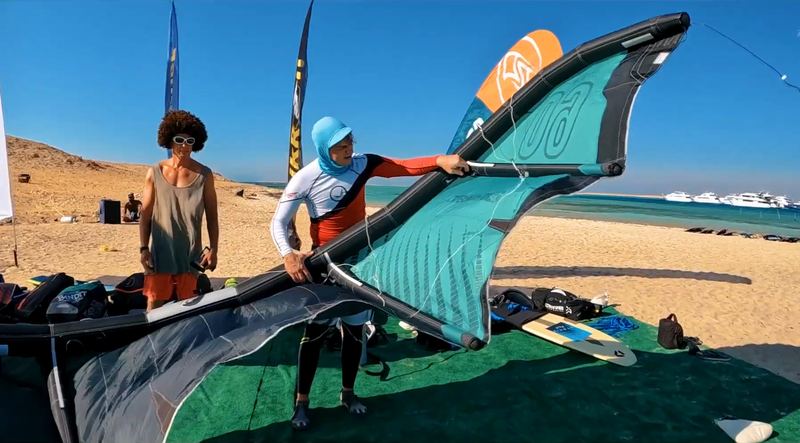
Before your first flight
A trainer kite is a learning tool, and the Ozone manual is explicit that you should take lessons with a certified instructor before using it.
Pick a school that teaches the safety side properly, not just the fun part. How to choose a kite school walks through what to look for. And if you are still deciding whether kitesurfing is for you at all, is it hard or dangerous answers that honestly.
Once you have flown a trainer, practised the release and understood the wind window, you have the groundwork for the water, where an instructor takes over.
Questions
What is a trainer kite?
A trainer kite is a small kite for learning kite control on land. By IKO's definition it is any kite that does not create enough power to pull you off balance or cause even a light injury. It teaches steering, the wind window and safety releases before you get on the water.
How big should a trainer kite be?
For example, the Ozone Ignition V3 comes in 1.5, 2.0, 2.5 and 3.0 m, and the maker recommends 2 m or 2.5 m, smaller for stronger wind and larger for light wind. Children should use 1.5 m in wind under 10 knots (5 m/s) and always under adult supervision.
Should I get a 2-line or 3-line trainer kite?
A 2-line trainer comes with a bar and a wrist leash. A 3-line version adds a release or stall line, which makes it easier to recover the kite after a crash. Both must have all safety features.
How much wind is safe for a trainer kite?
Start below 10 knots (5 m/s). The Ozone trainer manual says never to learn in wind above 10 knots (5 m/s), and never in a thunderstorm or offshore wind near water. You also need at least 100 m of free space downwind and to both sides.
Can I learn kitesurfing with a trainer kite alone?
No. A trainer teaches kite control, the wind window and releases, but not body dragging or the waterstart. IKO recommends using a trainer at least until your first body drag exercises, then continuing with a certified instructor.
Do I need lessons before flying a trainer kite?
The Ozone trainer manual states you should take lessons with a certified instructor before use. A trainer kite is a learning tool, not a replacement for a course.
Sources and fact checks (8)
- IKO defines a trainer kite as any kite that does not create enough power to pull a student off balance or cause light injury, and lists foil and LEI trainer types with 5-15 m lines. d8.ikointl.com (checked 25 October 2026)
- Ozone Ignition V3 trainer comes in 1.5, 2.0, 2.5 and 3.0 m, with 2 m or 2.5 m recommended and 1.5 m for children in wind under 10 knots. powerkiteshop.com (checked 25 October 2026)
- Ozone trainer foil manual describes 2-line and 3-line setups, the wrist leash release, start and landing procedure, and steering by pulling one side of the bar. ozonekites.com (checked 25 October 2026)
- The manual requires at least 100 m of free space downwind and to both sides, and says never to learn in wind above 10 knots. ozonekites.com (checked 25 October 2026)
- The manual gives care instructions - dry the kite out of the sun, never store it wet in the bag, check lines before every use. ozonekites.com (checked 25 October 2026)
- Body dragging is being pulled through the water without a board and is recommended before trying the board after trainer kite flying. www.seabreeze.com.au (checked 25 October 2026)
- The kite clock places 12 o'clock at zenith and 9 and 3 o'clock as the start and landing positions, with the edge of the window giving minimum power. d8.ikointl.com (checked 25 October 2026)
- Beginners learn with short lines that limit the build-up of power. en.wikipedia.org (checked 25 October 2026)