What is a kiteboard
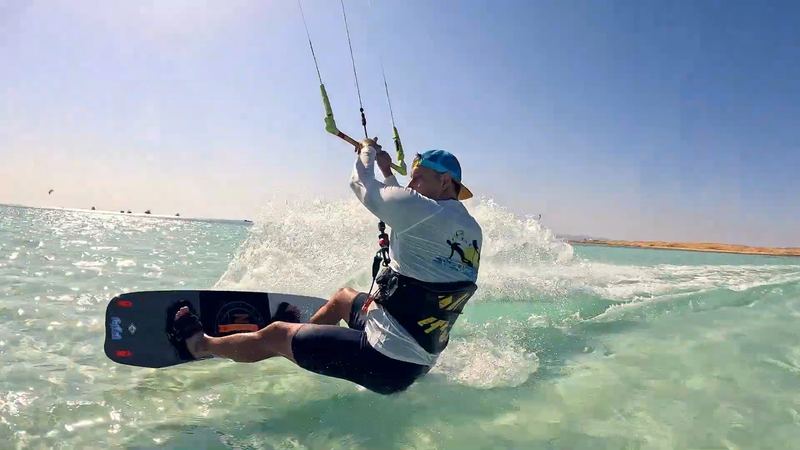
A kiteboard is the board you stand on while a kite pulls you across the water. There are three main types: twintip, directional surfboard and foilboard.
A kiteboard is the board you stand on while a kite pulls you across the water. It is a small board made of composite, wood or foam, and it is the piece of gear that connects your feet to the sport. Kiteboard, kite board and kitesurf board all mean the same thing on the water.
There are three main types: a twintip, a directional surfboard and a foilboard. They differ in shape, in which way they ride and in what they are built for. Most people start on a twintip, because it is the easiest to learn on and by far the most popular.
Kiteboard, kite board, kitesurf board: what is the difference?
The words describe the same object. A kiteboard is the board, and kiteboarding or kitesurfing is the sport you do on it. On the water the two sport names mean the same thing.
Regional habits differ. In Britain, riding a board on the water is called kitesurfing, while in the US the usual word is kiteboarding. In Britain, kiteboarding can also mean the land version on a wheeled board.
That land version is a different piece of gear. On land, land kiting uses a short, light mountainboard with wheels, a buggy, inline skates or a sandboard, and on snow you use skis or a snowboard. None of those is a kiteboard in the water sense.
If you want the wider picture of the sport and how the names fit together, see what kiting, kitesurfing and kiteboarding actually are.
The three types of kiteboards
The three types are not variations of one design. Each is built for a different way of riding, and the differences start with the shape.
| Type | Shape | Direction | Where it is used | For whom |
|---|---|---|---|---|
| Twintip | Symmetrical, nose and tail identical | Rides both ways | Flat water, chop, jumps | Beginners, freeriders, freestylers |
| Surfboard (directional) | Nose and tail like a surfboard, fins at the tail | One direction only | Waves, downwind | Wave riders |
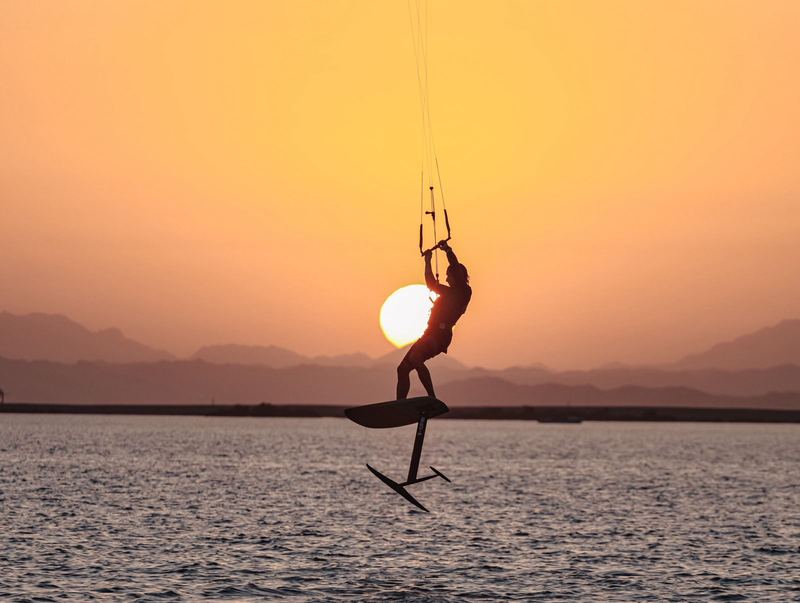
| Foilboard | Full carbon, mast and wings at the tail | One direction only | Light wind, foiling | Riders moving to foiling |
Twintips are bidirectional, so it does not matter which end points forward. Surfboards and foilboards are directional: the nose always points in the direction of travel and the tail does not. Surfboards carry fins at the tail, and foilboards carry the foil mast there.
Duotone also sorts boards into categories such as freeride, freestyle, waves, racing and big wave. Those categories cut across the three types and describe the riding style rather than the shape.
Twintip: the most common kiteboard
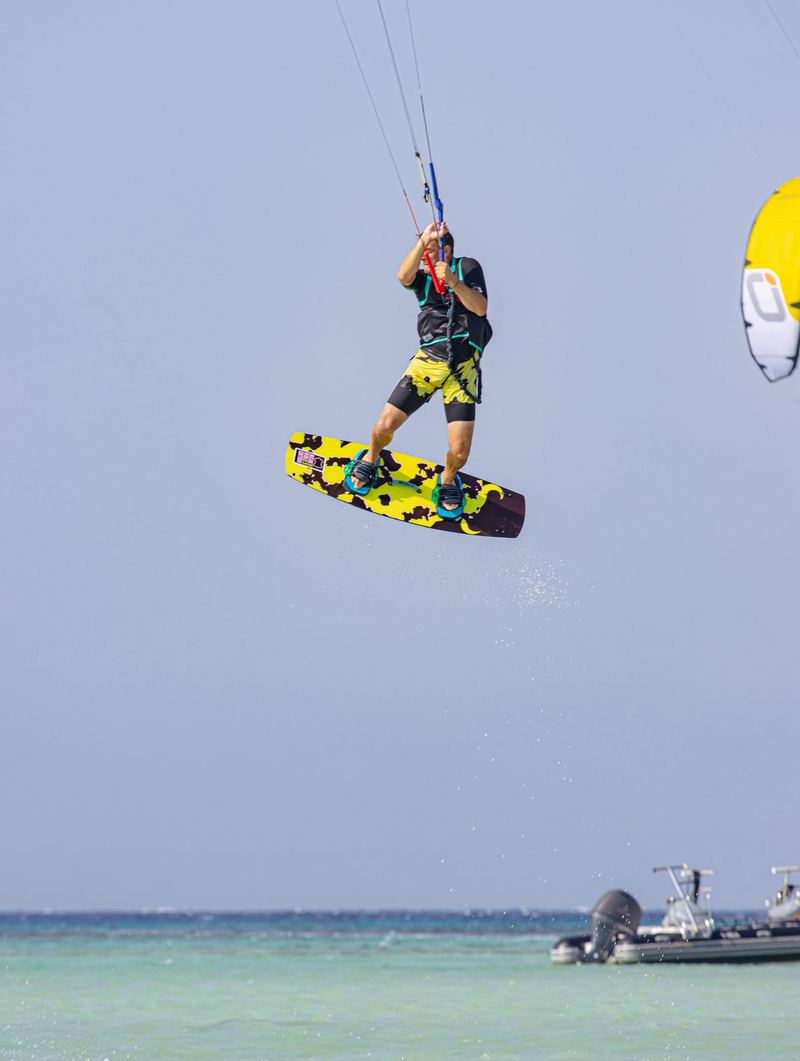
A twintip is the board most kiteboarders own first. It has a symmetrical shape, with the nose and tail the same, so you ride it in both directions without changing your foot position. That is what makes it practical for learning and for everyday riding.
It suits freeride, freestyle and big air, and it works on flat water, in choppy water and for jumps. The design details decide how it behaves: rocker (the curve of the board) with more curve gives a smoother ride in chop and softer landings, while less rocker is faster and easier upwind.
Flex works the same way. A soft flex gives comfort and stability, which suits beginners and freeride, while a stiff flex gives more pop and precision for freestyle and big air. The outline matters too: a rounder shape carves more easily, a squarer one adds speed and pop for jumps.
What a kiteboard is made of
A twintip is built from several layers. The core is usually wood, typically paulownia, which gives a natural flex. Over it come layers of glass fibre or carbon, which add strength, control and pop, and the rails are protected with ABS. A durable UV top sheet finishes the board.
Surfboards use a different build: a light EPS core with bamboo, Technora fibres and cork. Foilboards are full carbon with more volume under the front foot.
How your feet attach is a separate choice. On a twintip you can use boots, which are inspired by wakeboarding and give a fixed connection and control on landings, but carry a higher risk of injury in a fall and require a reinforced board. Or you use straps, which are looser, make it easier to do tricks without the board and release quickly in a fall, though the board is more easily lost in the water.
On a surfboard you ride with straps, pads or wax. Straps give more control in big waves, and riding without straps is the most popular trend. Foilboards are ridden with two or three straps or with none.
Parts of a kiteboard
The names help when you shop and when you talk to an instructor. According to IKO a kiteboard has these parts:
| Part | What it does |
|---|---|
| Deck and inserts | the top of the board; foot straps and fins are screwed into the inserts |
| Handle | a grip for carrying the board |
| Foot pads and foot straps | the pads and straps that hold your feet on the board |
| Rocker | the curve of the bottom from tip to tip: a flatter rocker is faster, a more curved one more manoeuvrable |
| Outline | the overall shape: a curved outline turns faster but has less balance, a straight one holds an edge better upwind |
| Rails (edges) | the sides of the board: a sharp rail adds control, a soft one is more forgiving and better for beginners |
| Bottom | the underside, flat, concave or with channels |
| Fins | keep the board tracking and reduce drift downwind; larger fins grip more, smaller ones let the board slide |
Width changes how a board behaves. A wider board is more stable on landings, planes sooner and suits gusty or light wind, while a narrower one is faster in strong wind and easier to put on edge.
How big should a kiteboard be?
Size follows weight and conditions. The rough guide below is Duotone's rule of thumb for twintips.
| Rider weight | Twintip length |
|---|---|
| Up to 60 kg | 128-134 cm |
| 60-75 kg | 135-139 cm |
| 75-90 kg | 140-145 cm |
| Over 90 kg | 145-150 cm |
A larger board makes it easier to get going, gives more buoyancy and stability, and as you gain experience you can move to a smaller one for more control. Beginners and light wind suit a board around 140-145 cm, while advanced riders use 132-138 cm for more control in stronger wind.
Directional boards are sized differently, in feet and inches. Beginners on a surfboard use 5'10"-6'0", advanced riders 5'4"-5'8", and heavier riders or light wind call for more volume.
Always check the size chart of the specific model. For the full tables and how width changes the ride, see kiteboard size: how long and wide your twintip should be.
Which kiteboard for whom
The short version: start on a twintip, move to a surfboard when you want waves, and consider a foil when you want to ride in light wind.
- Twintip: first board for almost everyone, and the base for freeride, freestyle and jumps.
- Surfboard (directional): for waves and downwind riding, once you are comfortable riding upwind and turning.
- Foilboard: for light wind and foiling, harder to learn but it opens up days when there is barely any wind.
I'd start on a twintip after a course, because it is the board the learning progression is built around. The detailed comparison of shapes and riding styles is in which kitesurf board: twintip, surfboard or foil, and the light wind options are covered in kitesurfing in light wind: big kite, light wind board or foil.
If foiling is what caught your eye, the basics are in what a kitefoil is. And if you are still assembling your first setup, the order of buying is in the kitesurf gear guide.
Care and transport
A kiteboard lasts longer with a few habits. Rinse it with fresh water after every session and let it dry completely. Do not leave it in direct sun or in a hot car, because UV and heat weaken the materials.
For transport, use a padded boardbag. Check the fins, screws and straps regularly, and replace anything that looks worn before it fails on the water.
Rinse, dry, bag it
Those three steps cover most of what a board needs. How to choose a bag and pack for a flight is in kiteboard bag: choosing, packing and flying with kite gear.
On a kite safari, a twintip can be rented rather than carried, at 60 EUR for 6 days according to the 2026 price list, and full kite gear is 300 EUR for 6 days. See the kite safari in Egypt page for the details.
Questions
What is a kiteboard?
It is the board you stand on while a kite pulls you over the water. Most people start on a twintip, which rides in both directions.
Is a kiteboard the same as a kitesurf board?
Yes. Kiteboard, kite board and kitesurf board all mean the same board on the water. The sport is called kiteboarding or kitesurfing.
What is the difference between a twintip and a directional board?
A twintip is symmetrical and rides both ways without changing your stance. A directional surfboard or foilboard has a nose and a tail, so it only rides one way.
How long should my kiteboard be?
As a rough guide, riders up to 60 kg use 128-134 cm, 60-75 kg use 135-139 cm, 75-90 kg use 140-145 cm and riders over 90 kg use 145-150 cm. Always check the size chart of the specific model.
Can I learn on a foilboard?
A foilboard is harder to master, but it lets you ride in very light wind. Most beginners start on a twintip first.
Sources and fact checks (14)
- Twintips are ideal for beginners and freeriders and ride in both directions; directional boards are for waves and downwind; foilboards glide in light wind. www.duotonesports.com (checked 25 October 2026)
- Twintips are bidirectional, while surfboards and foilboards are directional with a fixed nose and tail. www.duotonesports.com (checked 25 October 2026)
- Size by weight ranges from 128-134 cm up to 145-150 cm. www.duotonesports.com (checked 25 October 2026)
- A twintip uses a wood core with glass and carbon layers; surfboards use EPS, bamboo, Technora and cork; foilboards are full carbon. www.duotonesports.com (checked 25 October 2026)
- Foot attachment is either boots or straps, with different trade-offs for control and injury risk. www.duotonesports.com (checked 25 October 2026)
- Rocker, flex and outline change how a twintip rides in chop, upwind and for pop. www.duotonesports.com (checked 25 October 2026)
- Care includes rinsing with fresh water, avoiding direct sun and hot cars, using a padded boardbag and checking fins, screws and straps. www.duotonesports.com (checked 25 October 2026)
- Beginners or light wind suit a larger board around 140-145 cm; advanced riders use 132-138 cm. www.duotonesports.com (checked 25 October 2026)
- Surfboards are directional, beginners use 5'10"-6'0" and advanced riders 5'4"-5'8". www.duotonesports.com (checked 25 October 2026)
- A kiteboard is a small board of composite, wood or foam; twintips are the easiest to learn on and the most popular. en.wikipedia.org (checked 25 October 2026)
- On land, land kiting uses a mountainboard, buggy, inline skates or sandboard instead of a kiteboard. en.wikipedia.org (checked 25 October 2026)
- In Britain the water sport is called kitesurfing and in the US kiteboarding; in Britain kiteboarding can also mean the land version on a wheeled board. thekitesurfcentre.com (checked 25 October 2026)
- Kite safari 2026 price list rents a twintip for 60 EUR per 6 days and full kite gear for 300 EUR per 6 days. paradisekitesurf.cz (checked 25 October 2026)
- Board parts (deck, inserts, handle, pads, straps, rocker, outline, rails, bottom, fins) and their effect; IKO advises against a board leash. d8.ikointl.com (checked 25 October 2026)