Kitesurfing terms: the glossary beginners actually need
Kitesurfing terms are the words kiters use for equipment, wind, safety systems and riding technique. This glossary explains them in short entries, so you can follow a lesson, a shop conversation or a forecast.
Kitesurfing terms are the vocabulary of equipment, wind, safety systems and riding technique that kiters use every day. Below they are grouped by topic, with a link to a fuller article where one exists.
Kite and bar
- Kite - the wing that pulls you; in kitesurfing it is inflated or made of air cells and steered with lines from a bar. What is kiting
- LEI - leading edge inflatable, an inflatable kite with a tube frame. Parts of a kite
- Foil kite / ram air - a kite built from air cells without an inflatable frame.
- Closed cell - a foil kite with valves that hold air inside, which is what makes it usable on water.
- C-shape (C-kite) - the oldest LEI shape, with punchy power and a smaller wind range.
- Bow - a flat kite with the largest amount of depower.
- SLE (Supported Leading Edge) - a kite where a bridle supports the leading edge.
- Delta - a triangular shape, a simplified hybrid.
- Leading edge - the front inflatable tube of a kite. Parts of a kite
- Strut - an inflatable spar running across the kite.
- Canopy - the fabric between the tubes.
- Trailing edge - the rear edge of the kite.
- Wing tip - the outer end of the kite.
- Bridle - helper lines that spread the load along the leading edge.
- Pigtail - a short loop of line between the kite and the main lines.
- Bladder - the airtight bag inside a tube or strut.
- Aspect ratio - the ratio of a kite's span to its depth; higher means more power in light wind.
- Bar - the control bar you hold, connected to the kite by lines. Kite bar and lines
- Front / power lines - the front lines that carry the kite's pull. Kite bar and lines
- Back / steering lines - the rear lines that steer the kite.
- Center line - the middle line that runs through the bar to the chicken loop.
- Trim strap - the strap used to set the kite's minimum angle of attack, and so how much power it gives.
- 5th line - a fifth line that makes relaunching a C-kite easier.
- Line winders / bar ends - the ends of the bar that the lines are wound around.
- Floaters - foam floats on the lines above the harness that keep the bar from sinking.
Safety
- Chicken loop - a fixed rubber loop on the center line that passes through the bar and attaches it to your harness, so the pull is carried by your whole body.
- Chicken finger / bone - a hard tab on the chicken loop that goes through the harness hook to stop accidental release.
- Quick release - the mechanism on the chicken loop that disconnects the kite. Quick release and safety leash
- Safety line (re-ride) - the sliding safety line that stays connected to the kite after you use the quick release.
- Stopper ball - a stop on the safety line that keeps a released bar from sliding all the way to the kite.
- Kite leash - the safety line from your harness to the kite.
- Spreader bar - a stainless bar on the harness with a hook for the chicken loop.
- Line cutter - a knife for cutting lines, carried on the harness.
- Buoyancy aid - flotation gear; the IKO minimum is 50 N.
- Impact vest - a vest with little flotation, not suitable as the only buoyancy aid for beginners.
- Helmet - a perforated, foam-padded water sports helmet.
- IKO - International Kiteboarding Organization; its certificate shows your level.
- Kitemare - slang for an accident or a dangerous situation while kitesurfing.
- Lofted - lifted high by a strong gust, very dangerous near the ground and near obstacles.
- Hindenburg - when the kite stalls and falls out of the sky, from too little wind or from the kite getting upwind of the rider in the window.
Board and harness
- Twin tip - a symmetrical board that rides in both directions. What is a kiteboard
- Directional board - a board with a nose and tail that rides one way, used for surf, foil and racing. Board types
- Rocker - the curve of the board's bottom; flat is faster, curved turns better.
- Outline - the overall shape of the board; a curved outline turns faster but has less balance, a straight one holds an edge better upwind.
- Rail - the side edge of the board; a sharp rail adds grip, a soft one forgives.
- Fins - the fins under the board; they stabilize its direction and reduce drift downwind.
- Foot pads, foot straps - the pads and straps that hold your feet.
- Flex - how stiff the board is.
- Waist harness - a harness worn around the waist. Kite harness guide
- Seat harness - a harness you sit in, popular in schools.
- Trainer kite - a small kite for learning that, by the IKO definition, does not create enough power to pull you off balance. Trainer kite
Wind and window
- Wind window - the arc of sky downwind of you where a kite can fly, roughly 120-180 degrees. Wind window
- Zenith - the position directly above your head, a neutral spot for the kite.
- Power zone - the part of the sky with the most pull, usually 0-60 degrees from the center downwind direction.
- Apparent wind - the wind speed the kite sees, the sum of the real wind and the speed of the kite and rider; more apparent wind means more force.
- Onshore - wind blowing straight onto the beach from the water, hard for beginners. Offshore wind
- Offshore - wind blowing from the beach out to sea; never ride it without a rescue option such as a boat.
- Sideshore - wind running parallel to the beach, usually the best for kitesurfing.
- Side-onshore - wind between sideshore and 45 degrees onto the beach.
- Upwind - the direction the wind comes from; into the wind. Going upwind
- Downwind - the direction the wind blows; with the wind.
- Nuking - wind of 30-40 knots (15-21 m/s), extreme conditions.
- Overpowered - too much kite power. What size kite do I need
- Underpowered - too little power.
- Power up - an increase in the kite's power.
- Depower - reducing the kite's pull, usually by changing its angle of attack; bow kites can be depowered almost to zero.
- Luff - airflow around the kite breaks down, the kite flaps and can fall.
- Overhead waves - waves 2 m and higher, from trough to crest.
Riding and technique
- Edge - tilting the board's edge into the water to control direction, the basis of riding upwind.
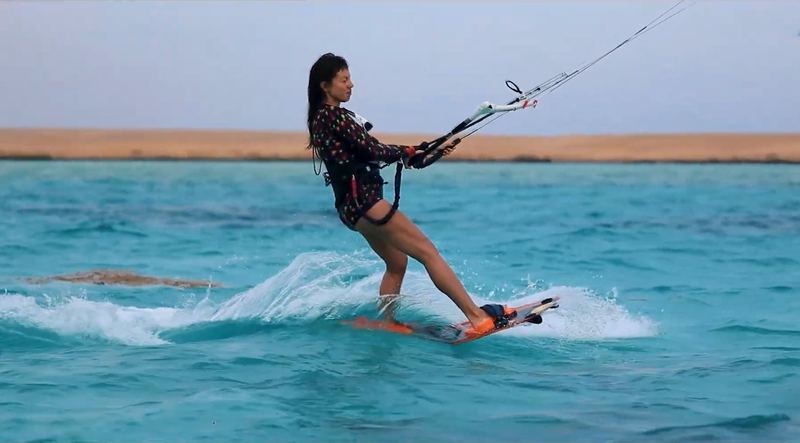
- Heelside - the side of the board where your heels are, the usual and most comfortable stance.
- Toeside - the side of the board where your toes are.
- Body dragging - being dragged through the water without a board, an early learning step after the trainer kite. Learn to kitesurf
- Waterstart - starting from the water onto the board. Waterstart
- Hooked-in - riding with the chicken loop attached to the harness.
- Unhooked - riding with the chicken loop not attached to the harness.
- Handlepass - passing the bar behind your back in the air while riding unhooked.
- Kiteloop - one of the strongest tricks: the rider loops the kite downwind while already in the air, with a strong surge of power.
- Boost - sending the kite so that the rider lifts off.
- Air time - the time spent in the air during a jump.
- Send it - aggressively driving the kite through the power zone.
- Tack - the direction of travel, starboard or port.
- Tea-bagging - bouncing up and out of the water repeatedly in light or gusty wind or with poor kite flying.
- Schlogging - riding extremely underpowered, with the board bouncing between planing and dragging.
- Downwinder - a long ride downwind from one place to another, usually needing a partner or a shuttle back, from 5 km to hundreds of kilometres. Downwind kite safari
- DP - dawn patrol, a very early morning session.
- Freeride - the most popular style, free riding. Kiteboarding styles
- Freestyle - jumps and tricks.
- Wakestyle - a crossover from wakeboarding.
- Mobe - a class of wakestyle tricks, an invert with a 360 degree rotation.
- Strapless - riding without foot straps.
- Foiling - riding with a hydrofoil. What is kite foiling
Most of these words only matter once you are on the water, but chicken loop, quick release and kite leash are worth knowing before your first session.
How the gear fits together is covered in the kitesurfing equipment guide.
Questions
What does depower mean in kitesurfing?
Depower is reducing the kite's pull, usually by changing its angle of attack. Bow kites can be depowered almost to zero.
What is a chicken loop?
A chicken loop is a fixed rubber loop on the center line that passes through the bar and attaches the bar to your harness. It holds the kite's pull through your whole body instead of your arms.
What is the wind window?
The wind window is the arc of sky downwind of you where a kite can fly, roughly 120-180 degrees. The power zone inside it, about 0-60 degrees from the center downwind direction, gives the most pull.
What is a downwinder?
A downwinder is a long ride downwind from one place to another. It usually needs a partner or a shuttle back, and can range from 5 km to hundreds of kilometres.
What is a trainer kite?
A trainer kite is a small kite used for learning. By the IKO definition it does not create enough power to pull you off balance, so you can practise control on land first.
What does kitemare mean?
Kitemare is slang for an accident or a dangerous situation during kitesurfing. It covers everything from a tangled line to a kite lofted near obstacles.
Sources and fact checks (5)
- Chicken loop, depower, wind window, power zone, zenith, apparent wind, edge, heelside and toeside definitions. www.seabreeze.com.au (checked 25 October 2026)
- LEI, foil kite, closed cell, C-shape, bow, SLE, delta, leading edge, strut, canopy, bridle, pigtail, bladder, lines, trim strap, 5th line, quick release, trainer kite, twin tip, directional board, rocker, fins, harness types, buoyancy aid and helmet. d8.ikointl.com (checked 25 October 2026)
- Depower, hooked-in, wakestyle, freeride, freestyle, strapless, foiling, aspect ratio and waterstart. en.wikipedia.org (checked 25 October 2026)
- Nuking means 30-40 knots (15-21 m/s) and offshore wind should never be ridden without a rescue option. www.seabreeze.com.au (checked 25 October 2026)
- A trainer kite does not create enough power to pull a beginner off balance. d8.ikointl.com (checked 25 October 2026)